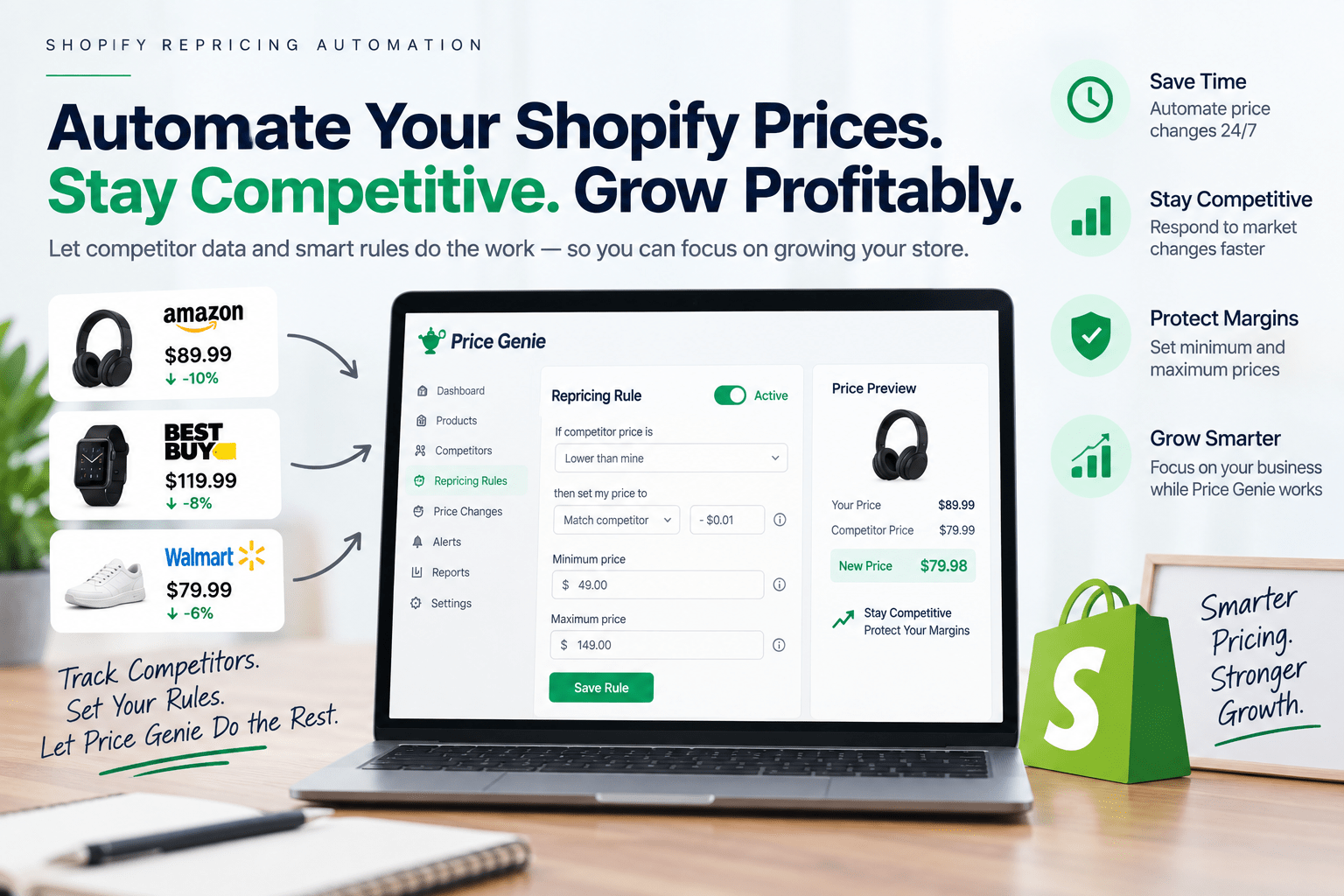
Shopify Automated Repricing: How to Automatically Adjust Product Prices
Managing product prices becomes increasingly difficult as a Shopify store grows. Competitors change prices, market conditions shift, and profit margins can quickly change. Fortunately, Shopify automated repricing can help merchants respond to these changes without manually updating every product price.
Instead of checking competitors and adjusting Shopify products one at a time, merchants can use Shopify repricing software to create pricing rules that determine when and how prices should change. As a result, pricing can become more efficient, consistent, and responsive to market conditions.
However, automated repricing should not simply mean lowering prices whenever a competitor does. A smarter strategy combines competitor information, pricing rules, minimum-price safeguards, and business goals. Therefore, the objective is not always to become the cheapest seller. Instead, the goal is to make better pricing decisions while protecting profitability.
What Is Shopify Automated Repricing?
Shopify automated repricing is the process of automatically adjusting Shopify product prices according to predetermined pricing rules, competitor prices, market conditions, or other pricing signals.
For example, a merchant might create a rule that keeps a product slightly below a selected competitor. Alternatively, the merchant could match a competitor's price while preventing the product from falling below a minimum acceptable price.
Therefore, automated repricing allows merchants to establish a pricing strategy in advance rather than manually deciding what to do every time a competitor changes a price.
How Does Shopify Repricing Software Work?
Shopify repricing software typically combines pricing information with rules established by the merchant. Once those conditions are met, the software can determine how a product price should respond.
Although individual repricing applications may operate differently, the general process can include:
- Monitoring selected products
- Tracking relevant competitor prices
- Detecting price changes
- Applying merchant-defined pricing rules
- Checking minimum or maximum pricing safeguards
- Adjusting Shopify prices when appropriate
Consequently, merchants can automate repetitive pricing decisions while maintaining control over the strategy behind those decisions.
Why Shopify Stores Use Automated Repricing
Online pricing can change quickly, especially when several retailers sell the same or similar products. Therefore, manually managing prices may become inefficient as the number of products and competitors increases.
Consider a Shopify store with 500 products. If the merchant monitors three competitors for only half of those products, that could still involve hundreds of competing product pages.
Moreover, a competitor's price could change between manual checks. By the time the merchant notices the change, the market may have already moved again.
For this reason, Shopify automated repricing can be particularly useful for merchants operating in competitive product categories.
Shopify Automated Repricing vs. Manual Repricing
Both manual and automated repricing can change product prices. However, the major difference is how much repetitive work the merchant must perform.
Manual Shopify Repricing
With manual repricing, the merchant typically researches competing prices, decides whether a change is necessary, logs into Shopify, and updates the product price.
For a small catalog, this approach may be manageable. However, as the store grows, manually repeating that process across many products can become time-consuming.
Automated Shopify Repricing
With Shopify automated repricing, merchants establish pricing rules and safeguards ahead of time. Then, when relevant pricing conditions occur, the repricing system can respond according to those instructions.
As a result, the merchant does not have to make the same type of pricing decision manually every time the market changes.
How to Automatically Adjust Product Prices on Shopify
Building an automated pricing strategy involves more than simply installing an application. Instead, merchants should first decide what they want their pricing rules to accomplish.
1. Identify Products That Need Shopify Automated Repricing
First, determine which products would benefit most from automated pricing.
Potential candidates include:
- Products sold by multiple retailers
- Frequently repriced products
- High-volume products
- Products with strong price competition
- Best-selling products
- Products where competitors frequently run promotions
Importantly, merchants do not necessarily need to automate every product immediately. Instead, starting with strategically important products can make the process easier to evaluate and refine.
2. Determine Your Competitive Pricing Strategy
Next, decide how you want your products positioned relative to competitors.
For example, a merchant might want to:
- Match a selected competitor
- Remain slightly below a competitor
- Remain slightly above a competitor
- Respond only when a competitor changes by a certain amount
- Maintain the current price under specific conditions
However, there is no single pricing strategy that works for every Shopify store. Therefore, merchants should consider their costs, margins, brand positioning, inventory, shipping, and customer expectations before establishing automated rules.
3. Set Minimum Prices Before Automating Repricing
Before allowing software to automatically adjust prices, establish safeguards that protect your business.
For example, suppose a product sells for $59.99 and your minimum acceptable selling price is $52.00.
A competitor suddenly lowers its price to $49.99.
Without a minimum-price safeguard, blindly following the competitor could push your price below an acceptable level. However, a properly configured repricing strategy can recognize the minimum threshold and prevent the price from moving below it.
Consequently, pricing automation can remain competitive without allowing competitors to completely control your pricing decisions.
4. Use Competitor Prices as a Pricing Signal
Competitor pricing can be extremely useful, but it should be treated as information rather than an absolute command.
A competitor may temporarily discount a product because of excess inventory, a promotion, different supplier costs, or a different business strategy.
Therefore, automatically matching every competitor price change may not make sense.
Instead, Shopify repricing software can help merchants combine competitor information with predetermined rules and pricing safeguards.
5. Monitor the Results of Automated Repricing
Automation does not mean merchants should completely ignore their pricing strategy after setting it up.
Instead, periodically review results and determine whether your rules continue to support your objectives.
For instance, consider whether:
- Your prices are changing too frequently
- Your margins remain acceptable
- Competitor prices are influencing your strategy appropriately
- Certain products need different rules
- Your minimum pricing thresholds need adjustment
Over time, these observations can help merchants refine their automated pricing strategy.
How Shopify Repricing Software Can Protect Profit Margins
One common misconception about repricing software is that its purpose is simply to lower prices. However, effective Shopify repricing software should also help merchants maintain control over profitability.
Consider two stores selling the same product.
Store A automatically lowers its price whenever a competitor does, regardless of margin. Store B also monitors competitors but establishes a minimum acceptable price based on its pricing strategy.
If competitors begin repeatedly undercutting one another, Store A could continue following prices downward. Store B, meanwhile, can stop repricing when its predetermined threshold is reached.
Therefore, automated repricing can be used not only to respond to competitors but also to enforce pricing discipline.
Shopify Automated Repricing Does Not Mean Always Being Cheapest
Your Shopify store does not need to have the lowest price to compete successfully.
Customers can consider many factors besides price, including:
- Brand reputation
- Product availability
- Shipping speed
- Return policies
- Customer service
- Product information
- Store trust
- Reviews
- Overall shopping experience
As a result, a merchant may intentionally price slightly above a competitor while providing additional value elsewhere.
Shopify also discusses different approaches to setting product prices in its product pricing guidance.
Shopify Repricing Software and Competitor Price Tracking
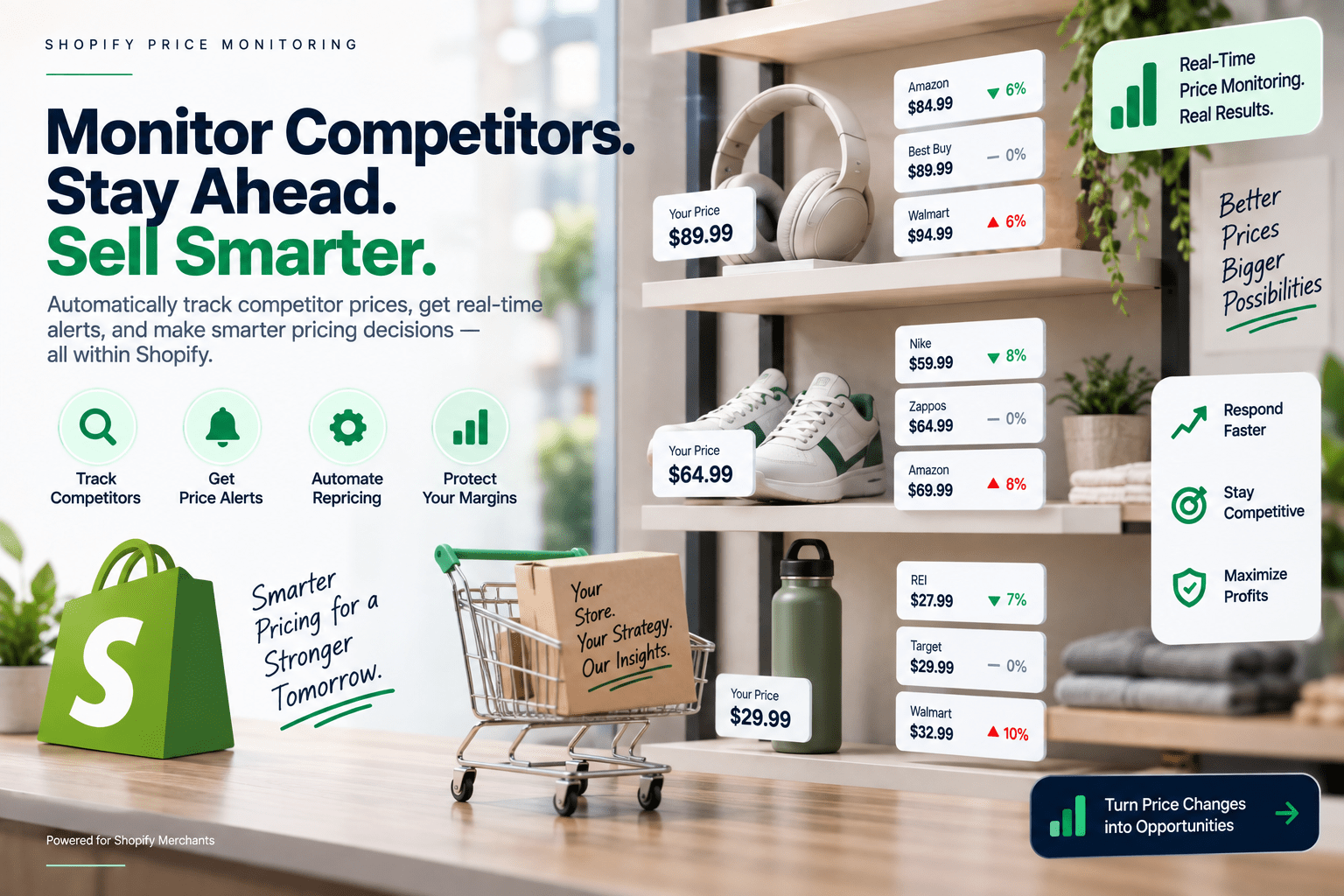
Automated repricing becomes even more useful when combined with competitor price tracking.
Competitor price tracking identifies what competing retailers are charging. Shopify automated repricing can then use that information as one of the inputs for deciding whether your own product price should change.
For example:
- A competitor changes a product from $79.99 to $74.99.
- Your monitoring system identifies the change.
- Your repricing rule evaluates the new competitor price.
- Your minimum-price safeguard is checked.
- Your Shopify price responds according to your predetermined strategy.
Therefore, competitor monitoring provides the information, while repricing rules determine how your store should respond.
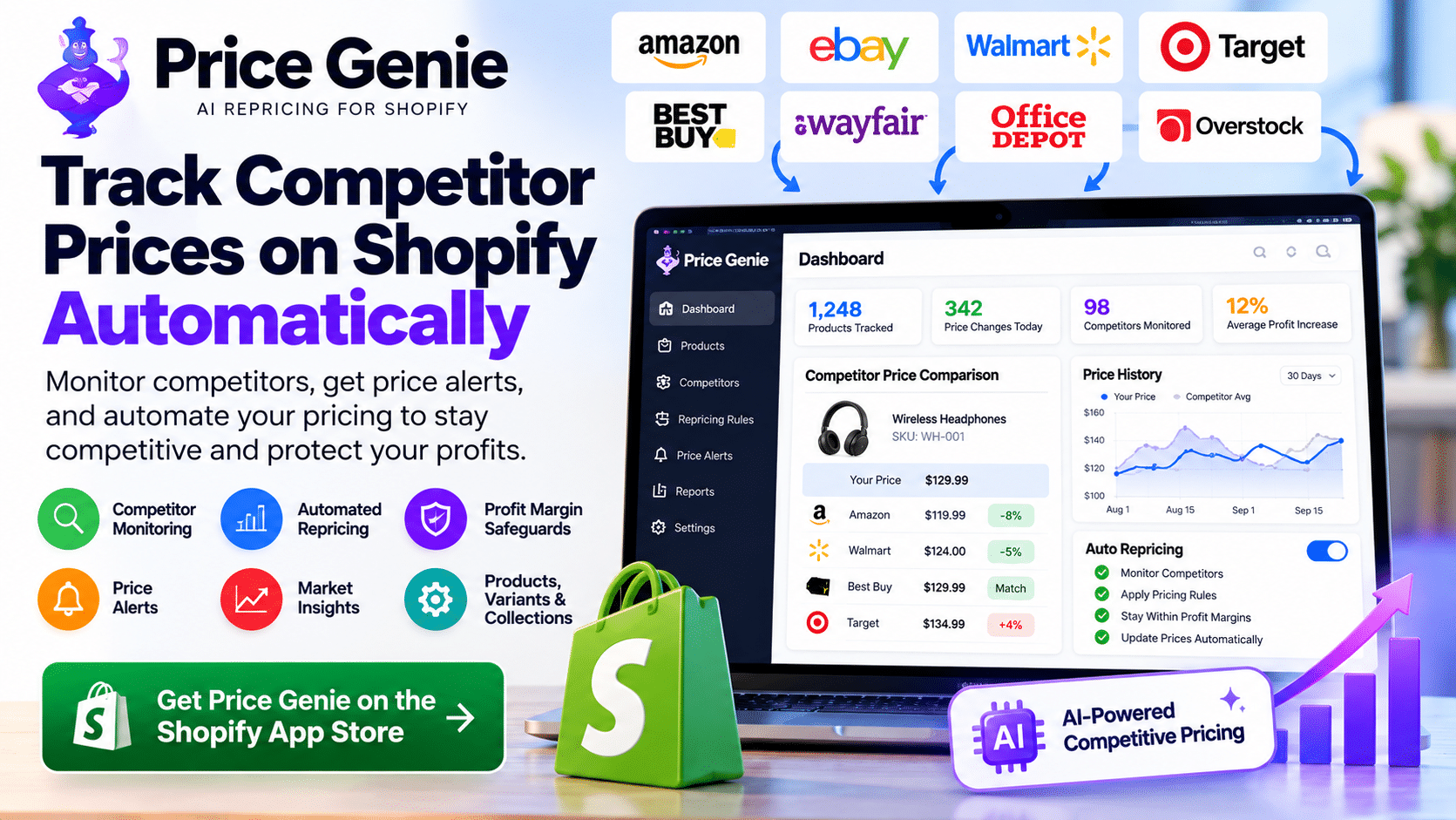
Price Genie combines these capabilities for Shopify merchants. Explore the Price Genie Shopify repricing features to learn more about competitor monitoring, automated pricing rules, alerts, dynamic pricing, and pricing safeguards.
Examples of Shopify Automated Repricing Strategies
Different stores can use automated pricing in different ways. Therefore, merchants should select strategies that align with their own business objectives.
Competitor Matching Strategy
A merchant may choose to match the price of a selected competitor when certain conditions are met. However, a minimum price can still be used to prevent unprofitable changes.
Price-Below-Competitor Strategy
Another approach is maintaining a product slightly below a selected competitor. For example, the rule might attempt to remain $1 below a competitor while respecting a minimum price.
Price-Above-Competitor Strategy
In some cases, merchants may intentionally remain slightly above competitors because of stronger branding, faster shipping, better customer service, or another advantage.
Minimum-Price Strategy
Merchants can establish a minimum acceptable price and prevent automated repricing from moving below that threshold. Consequently, competitive changes do not automatically override profitability considerations.
Conditional Shopify Repricing
More sophisticated strategies can use specific conditions before changing a price. As a result, merchants can create a more controlled response instead of reacting identically to every market movement.
Benefits of Shopify Automated Repricing
Automated Repricing Saves Time
First, automating repetitive price adjustments can reduce the amount of manual work required to manage a Shopify catalog. Consequently, merchants can spend more time on other areas of their businesses.
Shopify Repricing Software Responds More Efficiently
Competitor pricing can change quickly. Therefore, automation can help merchants respond according to predetermined rules without waiting for the next manual pricing review.
Automated Pricing Creates Consistent Rules
Without a defined strategy, merchants may make different pricing decisions from one product to another. In contrast, automated rules can create a more consistent approach.
Pricing Safeguards Can Help Protect Margins
Minimum-price restrictions can prevent a pricing rule from continuing downward beyond a merchant's predetermined limit. As a result, automation can support competitive pricing while maintaining greater control.
Shopify Automated Repricing Can Scale
Finally, a pricing process that works for 20 products may become difficult to manage manually across hundreds or thousands of products. Therefore, automation can become increasingly valuable as a Shopify catalog expands.
Common Shopify Automated Repricing Mistakes
Although automated repricing can save time, poorly designed rules can create unwanted results. Therefore, merchants should avoid several common mistakes.
Automatically Chasing the Lowest Price
Repeatedly undercutting competitors can contribute to shrinking margins. Instead, establish clear pricing boundaries before activating automation.
Ignoring Product Costs
A competitive price is not necessarily a profitable price. Therefore, merchants should understand their costs and acceptable margins before creating automated pricing rules.
Tracking the Wrong Competitors
Not every website selling a similar product is equally relevant. Instead, prioritize competitors your customers are realistically likely to compare with your store.
Creating One Repricing Rule for Every Product
Different products can have different margins, competitive environments, and strategic importance. Consequently, some product groups may require different pricing rules.
Never Reviewing Automated Pricing Rules
Markets change over time. Therefore, pricing rules that worked six months ago may eventually need to be updated.
Who Should Consider Shopify Repricing Software?
Shopify repricing software can be particularly useful for merchants selling products that are also available from competing online retailers.
For example, automated repricing may be useful for stores selling:
- Consumer electronics
- Beauty products
- Home and garden products
- Pet supplies
- Automotive accessories
- Sporting goods
- Tools and equipment
- Appliances
- Branded products
- Other products that shoppers frequently compare online
On the other hand, stores selling unique handmade products, proprietary merchandise, or highly customized items may have less need to follow direct competitor prices.
How Price Genie Supports Shopify Automated Repricing
Price Genie is built specifically for Shopify merchants who want greater visibility and control over competitive pricing.
Instead of manually checking competing websites and repeatedly updating product prices, merchants can use Price Genie to combine competitor monitoring with automated pricing strategies.
Price Genie provides Shopify merchants with tools for:
- Competitor price tracking
- Automated repricing rules
- Dynamic pricing automation
- Pricing safeguards
- Competitor alerts and insights
- Shopify pricing management
Most importantly, merchants remain in control of their strategy. Automation follows the pricing logic and safeguards established for the store rather than simply lowering prices without limits.
Frequently Asked Questions About Shopify Automated Repricing
What is Shopify automated repricing?
Shopify automated repricing is the process of automatically changing Shopify product prices according to predetermined pricing rules, competitor prices, or other pricing conditions. It can reduce repetitive manual price adjustments while allowing merchants to define how their pricing strategy should respond.
Can Shopify automatically change product prices?
Yes. Third-party Shopify pricing applications can provide automated repricing capabilities. Merchants can establish pricing rules that determine when and how product prices should change.
What is Shopify repricing software?
Shopify repricing software helps merchants automate product price adjustments based on pricing rules, competitor information, or other predetermined conditions. Depending on the software, merchants may also be able to establish safeguards designed to prevent prices from moving beyond selected limits.
Does automated repricing always lower prices?
No. Automated repricing does not have to mean lowering prices. Depending on the merchant's rules and market conditions, a price could decrease, increase, match a competitor, or remain unchanged.
Can automated repricing protect profit margins?
Pricing safeguards such as minimum-price thresholds can help prevent automated rules from moving a product below a merchant's predetermined acceptable price. However, merchants should still account for their actual costs and business requirements when establishing those thresholds.
What is the difference between competitor price tracking and repricing?
Competitor price tracking monitors competing product prices, whereas repricing determines whether your own product price should change. Therefore, competitor price data can serve as an input for an automated repricing strategy.
Does Price Genie offer Shopify automated repricing?
Yes. Price Genie is designed for Shopify merchants and combines competitor price monitoring with automated repricing tools, pricing rules, alerts, and safeguards.
Start Building a Smarter Shopify Repricing Strategy
Manually managing product prices can become increasingly difficult as your Shopify store grows. Moreover, competitor prices and market conditions may change faster than a merchant can reasonably monitor them by hand.
For that reason, Shopify automated repricing can provide a more scalable approach. By combining competitor information, merchant-defined pricing rules, and safeguards, stores can respond to changing market conditions while maintaining greater control over pricing decisions.
Ultimately, Shopify repricing software should not simply make products cheaper. Instead, it should help merchants implement their pricing strategies more efficiently and consistently.
Price Genie brings competitor monitoring and automated Shopify pricing tools together in one platform. Explore Price Genie pricing plans to find the option that fits your Shopify store.

0 Comments