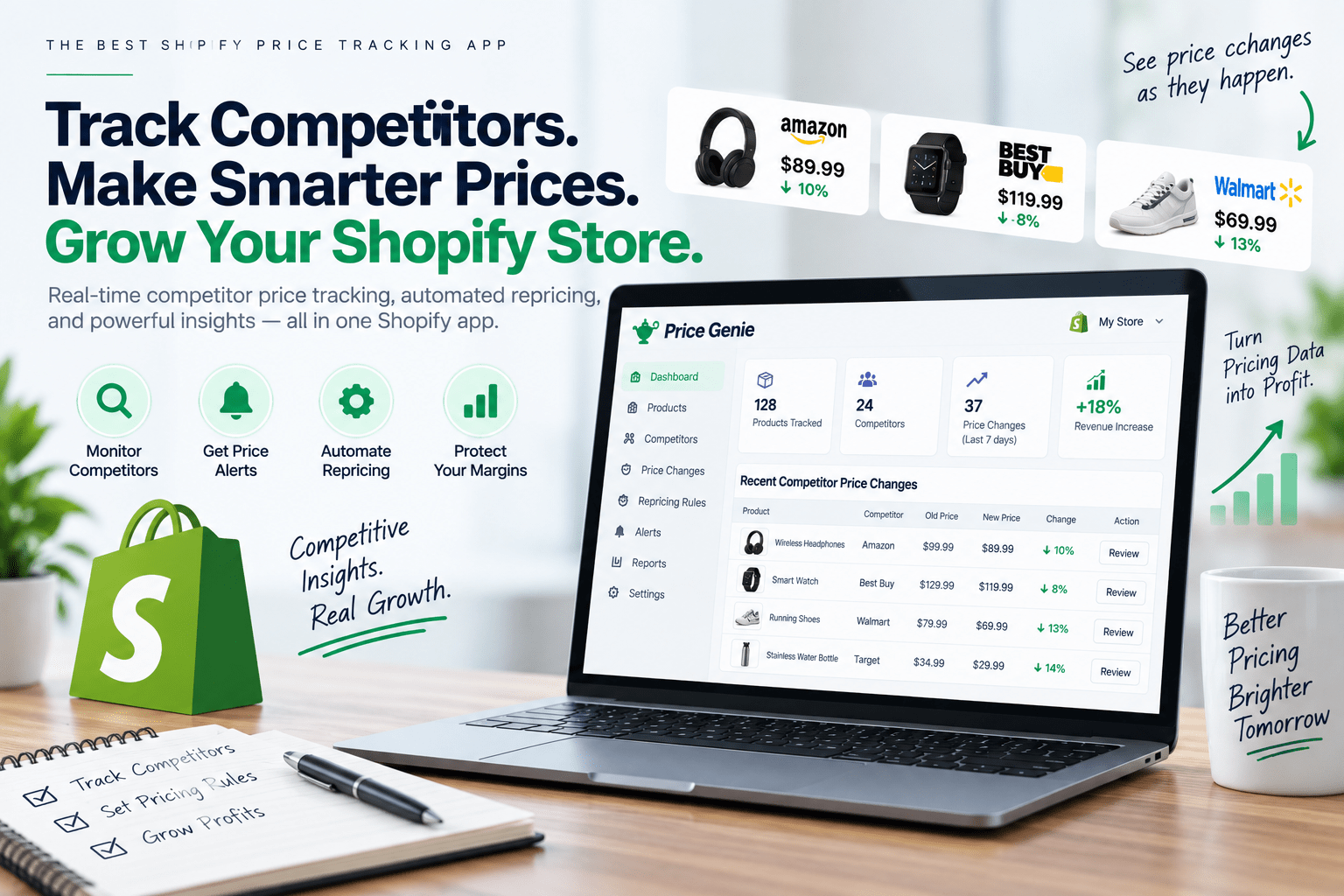
Best Shopify Competitor Price Tracking App: What to Look For
Keeping track of competitor prices can become difficult as a Shopify store grows. Competitors may change prices frequently, run promotions, or adjust their pricing strategies without warning. Fortunately, a Shopify competitor price tracking app can automate much of this monitoring and help merchants make more informed pricing decisions.
However, not every price tracking tool provides the same capabilities. When searching for the best Shopify price tracking app, merchants should look beyond basic price monitoring. Features such as automated repricing, pricing rules, competitor alerts, and minimum-price safeguards can make competitive pricing data much more useful.
Most importantly, the right application should help you understand the market without forcing you to manually check competitor websites every day. As a result, you can spend less time collecting pricing information and more time using that information strategically.
What Is a Shopify Competitor Price Tracking App?
A Shopify competitor price tracking app is software that helps Shopify merchants monitor competing product prices and identify when those prices change.
Rather than repeatedly visiting competitor websites and recording prices manually, merchants can use software to monitor selected competing products. Consequently, competitive pricing information becomes easier to manage as a Shopify catalog grows.
Depending on the software, merchants may also be able to create pricing rules, receive competitor alerts, automate repricing, and establish pricing safeguards.
In other words, competitor price tracking can become more than simply watching what other retailers charge. It can become part of a broader Shopify pricing strategy.
Why Shopify Stores Need Competitor Price Tracking
Online shoppers can compare prices quickly. In particular, when multiple retailers sell identical or similar products, customers may visit several stores before making a purchase.
For merchants, that creates an important question: how does your price compare with the rest of the market?
Without competitor monitoring, you may not know that:
- A major competitor lowered its price
- Several competitors recently increased their prices
- Your product is significantly more expensive than similar offers
- Your product is priced unnecessarily low
- A competitor started a temporary promotion
- Market pricing has changed since your last manual review
Because of these possibilities, a Shopify competitor price tracking app can provide valuable visibility into the competitive environment.
What Should the Best Shopify Price Tracking App Do?
The best Shopify price tracking app should do more than display competitor prices. Ideally, it should help merchants turn pricing information into useful decisions.
Although every Shopify business has different needs, several capabilities are particularly valuable.
1. Automatically Monitor Competitor Prices
First, the application should reduce the need for repetitive manual research.
Checking a few competitor products manually may be manageable. However, the process becomes much more difficult when a store needs to monitor dozens or hundreds of products across multiple retailers.
With automated monitoring, merchants can identify competitor price changes without repeatedly visiting every product page themselves.
As a result, less time is spent collecting pricing information and more time can be devoted to deciding how to use it.
2. Track Competitors That Actually Matter
A useful Shopify competitor price tracking app should allow merchants to focus on competitors that actually matter.
Not every retailer selling a similar product deserves equal attention. For that reason, merchants should prioritize businesses their customers are realistically likely to compare.
Relevant competitors could include:
- Other Shopify stores
- Independent ecommerce websites
- Large online retailers
- Online marketplaces
- Specialty retailers within your industry
Ultimately, relevant competitive data is more useful than simply monitoring the largest possible number of websites.
3. Provide Competitor Price Alerts
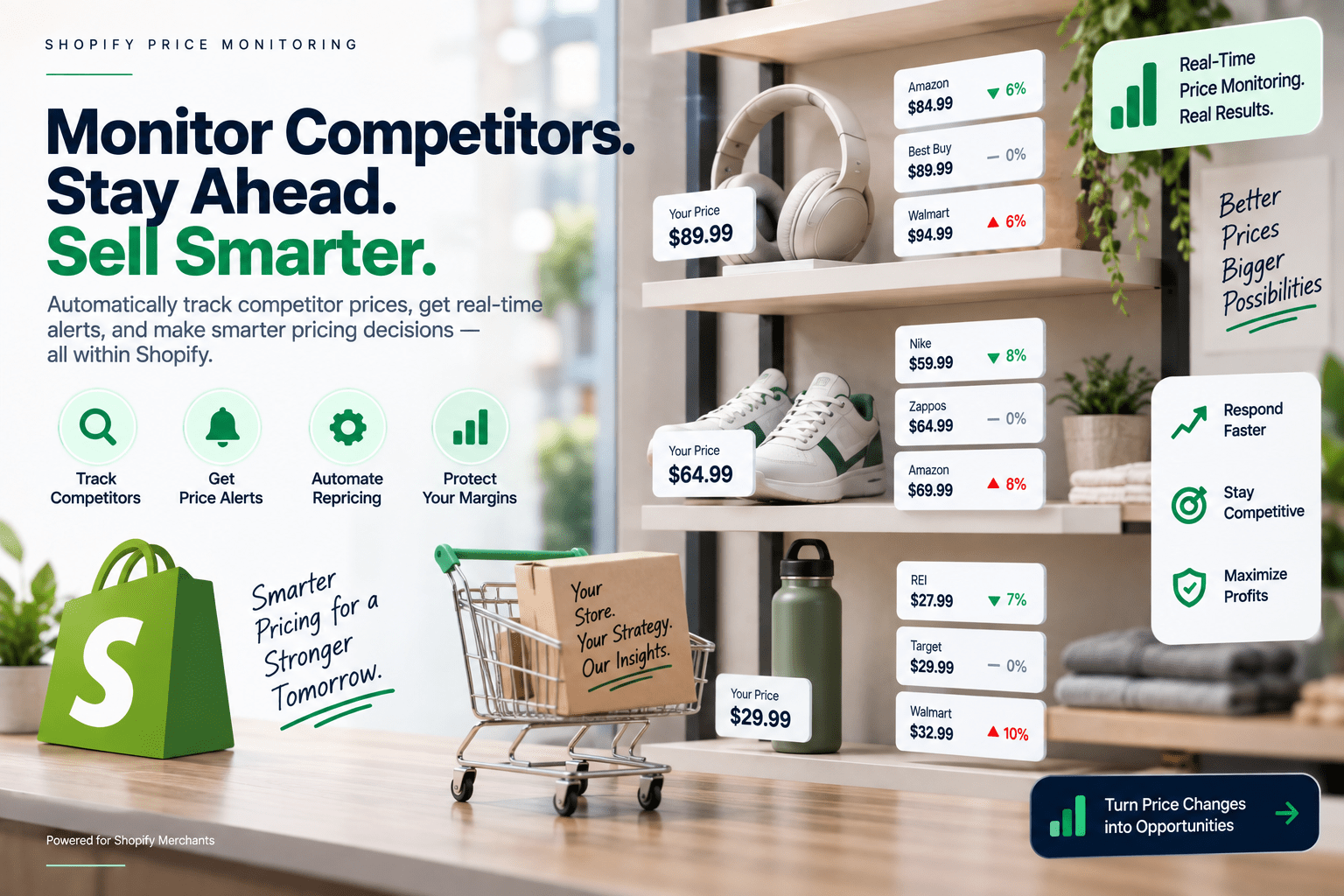
Knowing a competitor's current price is useful. Yet knowing when that price changes can be even more valuable.
For example, imagine that a competitor has sold a product for $79.99 for several months. Suddenly, the price drops to $69.99.
A pricing alert can bring that change to your attention so you can evaluate whether your own strategy should change.
On the other hand, an alert may reveal that a competitor increased its price. In that situation, you may discover that your own product is priced lower than necessary.
For this reason, alerts can help merchants identify both competitive threats and potential pricing opportunities.
4. Include Automated Shopify Repricing
Monitoring tells you what competitors are doing. Automated repricing takes the next step by determining how your own prices should respond according to rules you establish.
For example, a merchant could create a strategy designed to:
- Match a selected competitor
- Stay slightly below a competitor
- Remain slightly above a competitor
- Make no change under certain conditions
- Stop lowering a price when a minimum threshold is reached
By combining price tracking with automated repricing, merchants can reduce repetitive pricing work while maintaining control over the strategy.
Price Genie combines competitor monitoring and repricing tools specifically for Shopify merchants. You can explore the Price Genie Shopify pricing features to learn more about competitor tracking, pricing rules, alerts, and automation capabilities.
5. Protect Minimum Product Prices
Another important capability to consider is pricing protection.
Automatically following competitors without limits can create problems. For instance, another retailer may temporarily sell a product at an unusually low price because of excess inventory or a special promotion.
Suppose your product sells for $59.99, while your minimum acceptable price is $52.00.
Now imagine a competitor drops its price to $48.99.
Blindly matching that competitor would move your product below your predetermined threshold. A minimum-price safeguard, however, can help prevent the pricing strategy from crossing that limit.
For that reason, the best price tracking solution should not simply help merchants become cheaper. It should also help them maintain greater control over their pricing strategy.
Shopify Competitor Price Tracking App vs. Manual Tracking
Manual competitor monitoring and automated monitoring can provide similar information. However, the amount of work required can be dramatically different.
Manual Competitor Price Tracking
With manual monitoring, a merchant may need to:
- Search for competing products
- Visit competitor websites
- Record prices in a spreadsheet
- Repeat the process regularly
- Compare current prices with previous prices
- Decide whether Shopify prices need adjustment
For a very small catalog, this approach may be practical. As the number of products and competitors grows, though, the process becomes increasingly difficult.
Automated Shopify Competitor Price Tracking
In contrast, a Shopify competitor price tracking app can automate much of the monitoring process.
This means merchants do not have to rely entirely on spreadsheets, browser bookmarks, and manual price checks.
More importantly, automation can make competitor monitoring easier to scale as the Shopify store grows.
How to Choose the Best Shopify Price Tracking App
Choosing the best Shopify price tracking app depends on your products, competitors, catalog size, and pricing strategy.
Before selecting an application, consider several important questions.
Does the Price Tracking App Work Specifically With Shopify?
First, determine whether the platform is designed to work with Shopify.
Generic pricing platforms may support many ecommerce systems. A Shopify-focused solution, however, can provide a workflow designed specifically around Shopify merchants and product catalogs.
Can It Monitor the Competitors That Matter to You?
Next, determine whether the application can support your competitive monitoring strategy.
Your goal should not simply be collecting random competitor prices. Instead, the system should help you monitor the retailers that influence your actual market.
Does the Shopify Price Tracking App Provide Pricing Automation?
Price tracking provides information. Merchants who want greater automation should also consider whether the software supports repricing rules.
For example, can the system help implement a rule based on competitor pricing while respecting predetermined pricing safeguards?
When it can, competitor data becomes actionable rather than simply informational.
Does It Include Pricing Safeguards?
This capability is particularly important.
Before automating price adjustments, merchants should establish limits that align with their pricing strategy.
Accordingly, look for tools that provide control over how far automated pricing can move.
Does It Reduce Manual Pricing Work?
Ultimately, software should make the process more efficient.
If merchants still need to manually research every competitor, compare every price, and update every Shopify product individually, the software may not provide much automation.
A better objective is reducing repetitive work while keeping the merchant in control of the pricing strategy.
Shopify Competitor Price Tracking vs. Repricing Software
Competitor price tracking and repricing solve two related but different problems.
Competitor price tracking answers:
What are my competitors charging?
Automated repricing answers:
What should my price do when competitive conditions change?
For example, a tracking system might identify that a competitor lowered a product from $89.99 to $84.99.
Afterward, a repricing rule could evaluate the change and determine whether your own price should decrease, remain unchanged, or respond another way.
Together, both capabilities can create a more complete pricing workflow.
Best Shopify Price Tracking App for Dynamic Pricing Strategies
Dynamic pricing is another closely related concept.
Shopify dynamic pricing allows product prices to respond to predefined pricing conditions or signals.
Competitor pricing can be one of those signals. Dynamic pricing, however, is the broader strategy, while competitor monitoring provides information that can help support that strategy.
As a result, Shopify merchants may use competitor tracking, repricing, and dynamic pricing together rather than viewing them as completely separate tools.
Can a Shopify Price Tracking App Help Protect Profit Margins?
Yes, when the pricing strategy includes appropriate safeguards.
Price tracking by itself does not protect profitability. Instead, the merchant must determine appropriate pricing boundaries based on costs, margins, and business objectives.
For example, imagine that your product sells for $99 and a competitor lowers its price to $89.
You may decide to respond. However, if your predetermined minimum price is $92, automatically matching $89 may not fit your strategy.
In this situation, pricing software becomes more useful when competitive information is combined with merchant-controlled safeguards.
Should You Always Match the Cheapest Competitor?
No. A Shopify store does not always need to match the cheapest competitor.
Customers consider factors beyond price, including:
- Shipping speed
- Return policies
- Customer service
- Store reputation
- Product availability
- Reviews
- Brand trust
- Overall shopping experience
Additionally, competitors may have different product costs, supplier agreements, margins, or inventory objectives.
Consequently, another retailer's lowest price may not be the right price for your business.
Shopify provides additional guidance about evaluating product prices in its guide to determining product pricing.
Who Benefits Most From a Shopify Competitor Price Tracking App?
A Shopify competitor price tracking app can be especially useful when customers can easily compare the same or similar products across several retailers.
For example, price monitoring may be valuable for Shopify stores selling:
- Consumer electronics
- Beauty products
- Home and garden products
- Pet supplies
- Automotive accessories
- Sporting goods
- Tools and equipment
- Appliances
- Branded products
- Other products available from multiple retailers
In contrast, direct competitor price monitoring may be less important for stores selling unique handmade, customized, or proprietary products that shoppers cannot easily compare elsewhere.
How Price Genie Works as a Shopify Competitor Price Tracking App
Price Genie is designed specifically for Shopify merchants who want to monitor competitors and build a more automated pricing strategy.
Rather than manually checking competing product pages and repeatedly adjusting Shopify prices, merchants can use Price Genie to bring competitive monitoring and pricing automation together.
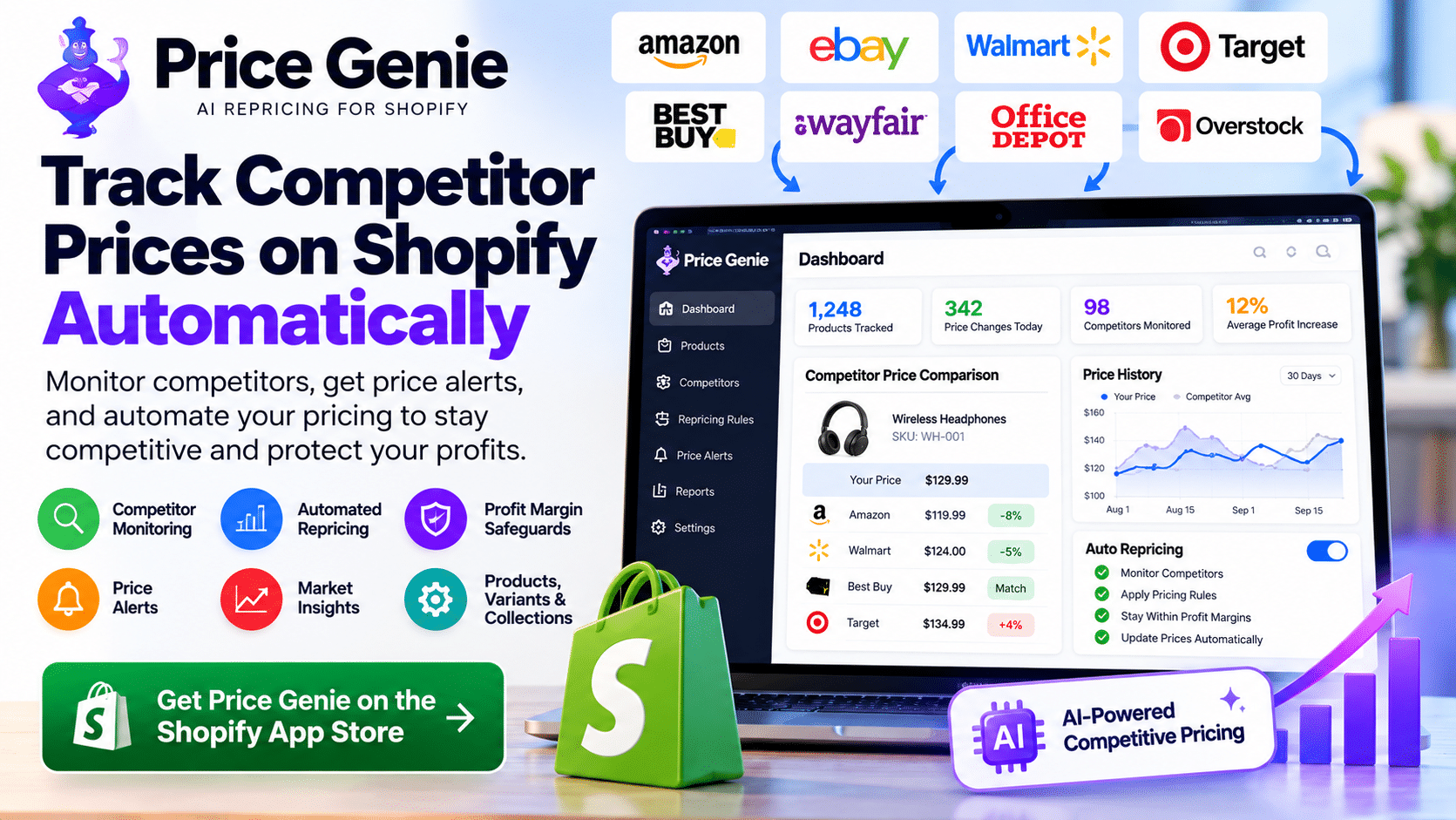
Price Genie provides tools for:
- Competitor price tracking
- Automated Shopify repricing
- Dynamic pricing automation
- Pricing rules
- Minimum and maximum pricing safeguards
- Competitor alerts and insights
- Shopify-focused pricing management
With these capabilities working together, merchants can use competitive pricing information as part of a larger pricing strategy instead of simply watching prices change.
Why Price Genie Is Built Specifically for Shopify Merchants
Price Genie focuses on Shopify rather than trying to serve every ecommerce platform.
That focus is important because Shopify merchants need pricing tools that fit naturally into their ecommerce workflow.
Additionally, Shopify continues to provide merchants with extensive tools for managing products, pricing, inventory, and ecommerce operations. You can learn more about the platform through the official Shopify website.
Price Genie complements that ecosystem by focusing specifically on competitor pricing intelligence and pricing automation.
Questions to Ask Before Choosing Shopify Price Tracking Software
Before selecting a competitor tracking application, merchants should consider what they actually need the software to accomplish.
Useful questions include:
- How many products do I need to monitor?
- Which competitors matter most?
- How frequently do prices change in my market?
- Do I only need tracking, or do I also want automated repricing?
- Do I need minimum-price safeguards?
- Do I want alerts when competitors change prices?
- Will I need to scale monitoring as my catalog grows?
By answering these questions first, merchants can evaluate applications according to their actual business requirements rather than simply choosing the longest feature list.
Frequently Asked Questions About Shopify Competitor Price Tracking Apps
What is the best Shopify price tracking app?
The best Shopify price tracking app is one that fits your store's competitive pricing strategy and provides the monitoring, automation, alerts, and pricing controls you actually need. Merchants who want more than basic tracking should also consider automated repricing and pricing safeguards.
Can Shopify track competitor prices automatically?
Yes. Shopify merchants can use third-party applications to automate competitor price monitoring. These tools can reduce the need to repeatedly visit competing product pages manually.
What does a Shopify competitor price tracking app do?
A Shopify competitor price tracking app monitors selected competing product prices and helps merchants identify pricing changes. Depending on the application, it may also provide alerts, automated repricing, pricing rules, and other competitive pricing tools.
Can Shopify price tracking software automatically change my prices?
Some pricing applications also provide automated repricing capabilities. In those cases, merchant-defined rules can determine how Shopify product prices respond to selected pricing conditions.
Should Shopify stores automatically match competitor prices?
No. Competitor pricing should be treated as useful information rather than an instruction to always match the lowest price. Costs, margins, brand positioning, shipping, service, and other business factors should also influence pricing decisions.
What is the difference between price tracking and repricing?
Price tracking monitors competitor prices, while repricing determines whether your own product price should change. In practice, competitor price information can be used as an input within an automated repricing strategy.
Can competitor price tracking help identify opportunities to raise prices?
Yes. Competitor monitoring is not only useful when competitors lower prices. When competing retailers increase their prices while yours remains substantially lower, that information may provide a reason to reevaluate your own pricing strategy.
Is Price Genie only for Shopify?
Yes. Price Genie is designed specifically for Shopify merchants who want competitor price monitoring and pricing automation tools.
Find the Best Shopify Price Tracking App for Your Pricing Strategy
Competitive pricing becomes increasingly difficult to manage manually as a Shopify store grows. Furthermore, competitors can change prices faster than merchants can reasonably monitor every product by hand.
A Shopify competitor price tracking app can help solve that problem by automating repetitive monitoring and providing greater visibility into changing market prices.
Beyond basic monitoring, the best Shopify price tracking app should help turn that information into useful pricing decisions. Automated repricing, pricing rules, alerts, and safeguards can all contribute to a more efficient competitive pricing strategy.
Price Genie brings these capabilities together specifically for Shopify merchants. Explore Price Genie pricing plans and discover a smarter way to monitor competitors and manage your Shopify pricing strategy.

0 Comments