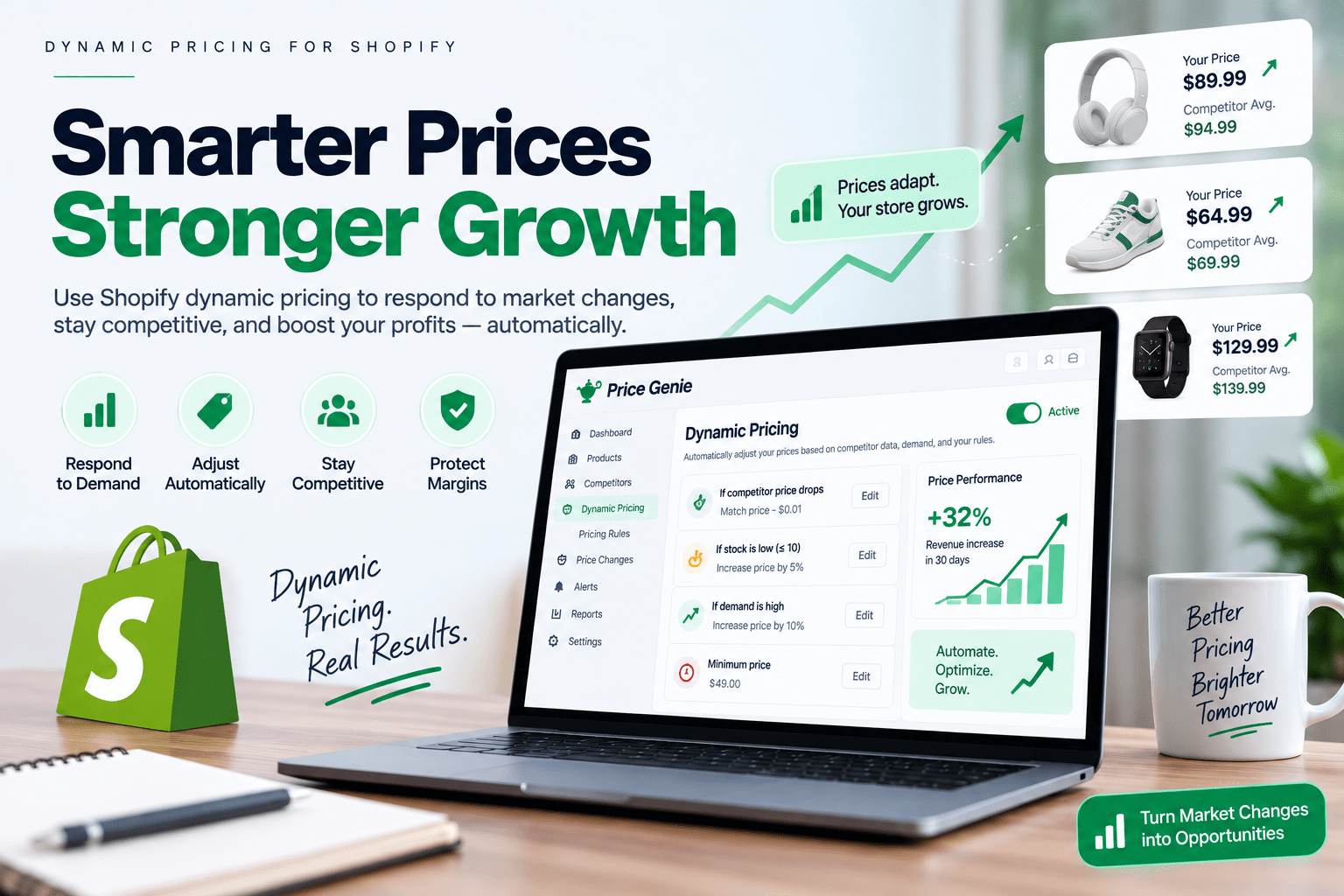
Shopify Dynamic Pricing: How to Build a Smarter Automated Pricing Strategy
Product prices do not always need to remain static. Competitors change their prices, market conditions shift, inventory levels change, and customer demand can rise or fall. Therefore, Shopify dynamic pricing can help merchants create a more flexible pricing strategy that responds to changing conditions.
Instead of manually reviewing every product and deciding when prices should change, merchants can use dynamic pricing software for Shopify to automate parts of the process. Pricing rules can then determine how products should respond when selected conditions are met.
However, dynamic pricing is not simply about lowering prices. A well-designed strategy can also maintain prices, increase them when appropriate, respond to competitor activity, and use safeguards to protect profitability. As a result, Shopify merchants can develop a more responsive pricing strategy while maintaining greater control.
What Is Shopify Dynamic Pricing?
Shopify dynamic pricing is a pricing strategy in which product prices can change according to predefined rules, competitive information, market conditions, or other relevant pricing signals.
Unlike static pricing, where a product remains at the same price until a merchant manually changes it, dynamic pricing creates a framework for prices to respond when certain conditions occur.
For example, a merchant might establish rules that respond when a competitor changes its price. Alternatively, different pricing rules could be applied according to the merchant's broader strategy.
Therefore, dynamic pricing gives Shopify merchants a way to make their pricing more responsive without manually evaluating every change individually.
How Does Dynamic Pricing Software for Shopify Work?
Dynamic pricing software for Shopify uses pricing information together with merchant-defined rules to determine when a product price may need to change.
Although individual platforms can work differently, a dynamic pricing process may include:
- Monitoring selected Shopify products
- Tracking relevant competitor prices
- Detecting pricing changes
- Evaluating merchant-defined pricing rules
- Checking minimum and maximum pricing safeguards
- Determining whether a price should change
- Updating product pricing according to the established strategy
Consequently, merchants can automate repetitive pricing decisions while maintaining control over the rules that guide those decisions.
Why Shopify Dynamic Pricing Matters for Ecommerce Stores
Ecommerce markets can change quickly. In particular, products sold by multiple retailers may experience frequent price changes as businesses compete for customers.
For example, a competitor may lower a price during a promotion. Another retailer may increase its price when inventory becomes limited. Meanwhile, your Shopify store could continue selling at the same price simply because nobody has manually reviewed the product.
Therefore, Shopify dynamic pricing can help merchants develop a more responsive approach to changing market conditions.
More importantly, dynamic pricing provides a framework for deciding how the store should react. Instead of making an isolated decision every time something changes, merchants can establish pricing logic in advance.
Static Pricing vs. Shopify Dynamic Pricing
Static and dynamic pricing both have a place in ecommerce. However, they take very different approaches to managing product prices.
What Is Static Pricing?
Static pricing means a product generally remains at the same price until the merchant manually changes it.
For example, a Shopify product could remain at $59.99 for several months even while competing retailers adjust their prices multiple times.
This approach is simple. However, it may require frequent manual monitoring when pricing competition is important.
What Is Dynamic Pricing?
With Shopify dynamic pricing, predefined conditions can influence when product prices change. Therefore, the pricing strategy can respond more efficiently to selected market signals.
For instance, competitor pricing could be one signal used by a dynamic pricing system. If a selected competitor changes its price, the merchant's rules can determine whether a response is appropriate.
As a result, dynamic pricing can make product pricing more responsive while reducing repetitive manual work.
Shopify Dynamic Pricing vs. Automated Repricing
Dynamic pricing and automated repricing are closely related concepts. However, they are not necessarily identical.
Automated repricing generally refers to automatically changing a product price according to established pricing rules.
Dynamic pricing is the broader strategy of allowing prices to respond to changing information or conditions.
For example, competitor price information might trigger an automated repricing rule. That repricing action can then become part of the store's broader dynamic pricing strategy.
Therefore, automated repricing can be one of the mechanisms used to implement Shopify dynamic pricing.
How Competitor Prices Can Support Shopify Dynamic Pricing
Competitor pricing is one of the most useful pieces of information for merchants selling products that shoppers can easily compare across multiple retailers.
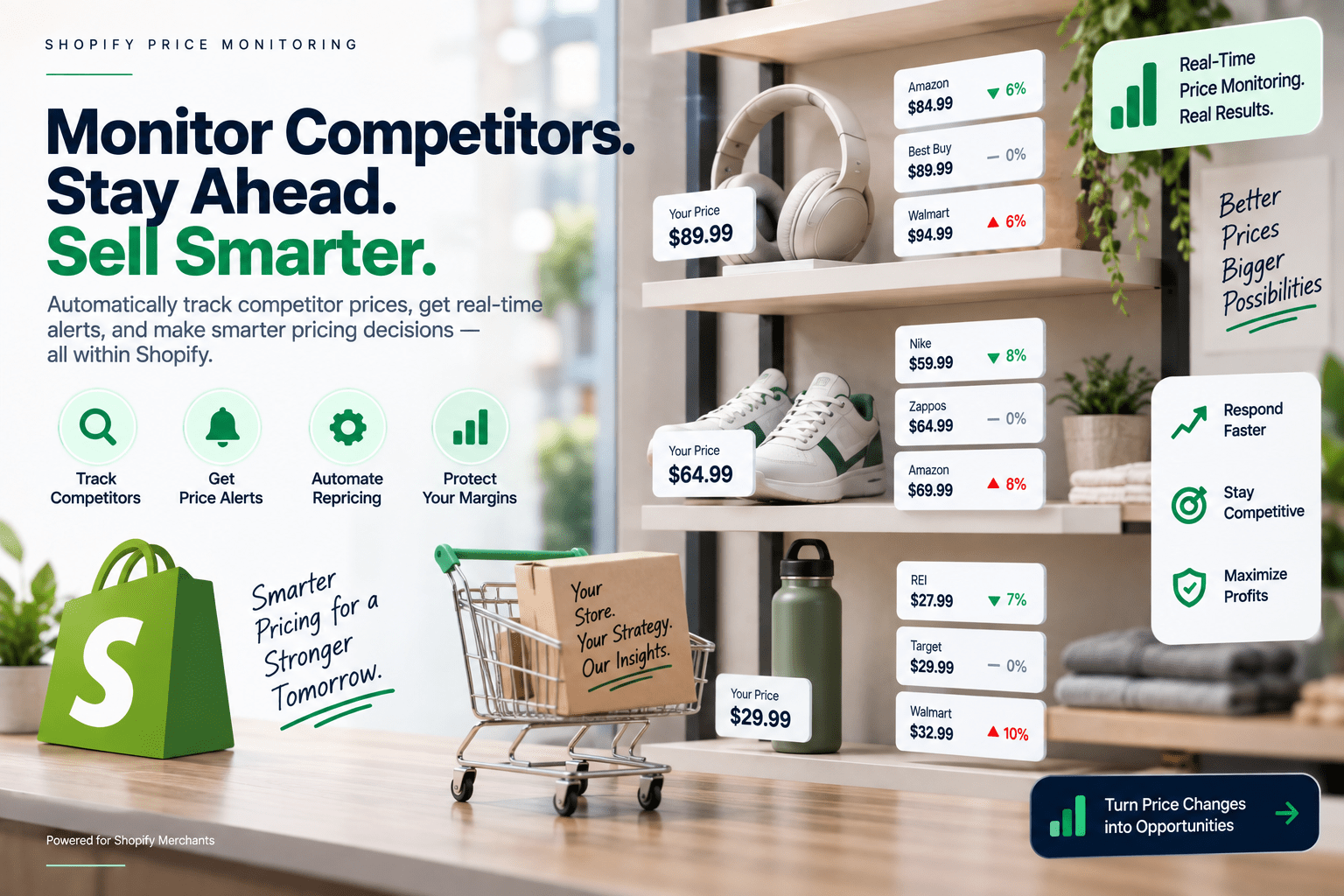
Suppose your Shopify store sells a product for $89.99. Meanwhile, a major competitor sells the same product for $84.99.
Competitor monitoring identifies that difference. However, the pricing data alone does not determine what your store should do.
Your dynamic pricing strategy could potentially:
- Match the competitor
- Remain slightly below the competitor
- Remain slightly above the competitor
- Keep the existing price
- Change only if the competitor price crosses a selected threshold
Therefore, competitor data becomes a pricing signal rather than an instruction to automatically become the cheapest seller.
How to Build a Shopify Dynamic Pricing Strategy
Effective dynamic pricing begins with a strategy. Before automating anything, merchants should determine what they want their pricing system to accomplish.
1. Choose Products for Shopify Dynamic Pricing
First, identify products where dynamic pricing could provide the most value.
Strong candidates may include:
- Products sold by multiple retailers
- Frequently repriced products
- Best-selling products
- High-volume products
- Products with strong price competition
- Products where competitors frequently run promotions
However, merchants do not necessarily need to apply dynamic pricing to every product. Instead, starting with products where market pricing matters most can make the strategy easier to manage.
2. Identify Relevant Competitor Prices
Next, determine which competitors actually matter to your customers.
Tracking every retailer on the internet can create unnecessary information. Therefore, merchants should focus on competitors that shoppers are realistically likely to compare with their store.
Depending on the business, relevant competitors could include:
- Other Shopify stores
- Large ecommerce retailers
- Online marketplaces
- Independent ecommerce websites
- Specialty retailers within the same industry
Ultimately, relevant pricing information is more valuable than simply collecting the largest possible amount of data.
3. Establish Shopify Dynamic Pricing Rules
Once relevant products and competitors have been identified, merchants can determine how prices should respond.
For example, a pricing strategy could attempt to:
- Match a selected competitor
- Stay a certain amount below a competitor
- Remain slightly above a competitor
- Maintain the current price under selected conditions
- Prevent a product from falling below a predetermined minimum
However, pricing rules should support the merchant's business strategy rather than simply copy competitor behavior.
4. Set Minimum and Maximum Pricing Safeguards
Pricing safeguards are particularly important when automation is involved.
Suppose your product currently sells for $74.99. Based on your costs and pricing strategy, you determine that you do not want it to sell below $67.00.
Then, a competitor suddenly lowers its price to $63.99.
Without a safeguard, an overly aggressive pricing rule could potentially follow the competitor below your preferred pricing threshold.
However, a minimum-price safeguard can help prevent the automated strategy from crossing your predetermined limit.
Therefore, dynamic pricing should combine responsiveness with control.
5. Review and Improve Your Dynamic Pricing Strategy
Finally, dynamic pricing should not be treated as a set-it-and-forget-it strategy.
Markets change. Competitors change. Product costs can change as well. Consequently, pricing rules should be reviewed periodically.
Merchants should consider questions such as:
- Are prices changing too frequently?
- Are pricing rules responding to the correct competitors?
- Are minimum-price safeguards appropriate?
- Are certain products performing better under different rules?
- Should some products remain manually priced?
Over time, these observations can help merchants refine their Shopify pricing strategy.
Dynamic Pricing Software for Shopify and Profit Margins
A common concern with automated pricing is profitability. Merchants may worry that automation will continuously lower prices whenever competitors become cheaper.
However, dynamic pricing software for Shopify does not have to operate that way.
Instead, merchants can establish pricing safeguards designed to keep automated changes within selected boundaries.
For example, imagine that a product costs your business $35 and currently sells for $59.99. A competitor suddenly drops the same product to $42.
Blindly following the competitor could significantly reduce your margin. Therefore, your pricing strategy may determine that no further reduction should occur after reaching a predetermined threshold.
As a result, dynamic pricing can be used to balance competitive responsiveness with margin protection.
Does Shopify Dynamic Pricing Always Lower Prices?
No. Shopify dynamic pricing does not necessarily mean lowering product prices.
Depending on the merchant's strategy and the pricing signals being used, a dynamic price could potentially move downward, upward, or remain unchanged.
For example, if competitors increase their prices, your store may discover that it is priced unnecessarily low. Depending on your strategy, that information could present an opportunity to evaluate whether your own price should increase.
Therefore, dynamic pricing should not be viewed simply as automated discounting. Instead, it is a method of making prices more responsive to changing information.
Benefits of Shopify Dynamic Pricing
Shopify Dynamic Pricing Can Save Time
First, automation can reduce repetitive pricing work. Instead of manually reviewing every competitor and updating each Shopify product individually, merchants can establish rules that guide the process.
Dynamic Pricing Can Improve Market Responsiveness
Additionally, ecommerce markets can change quickly. Therefore, dynamic pricing can help merchants respond to selected pricing signals more efficiently.
Pricing Rules Create Greater Consistency
Without a defined pricing strategy, merchants may make different decisions each time market conditions change. In contrast, predefined rules can create a more consistent framework for making those decisions.
Dynamic Pricing Software Can Help Protect Margins
Furthermore, minimum and maximum pricing safeguards can place boundaries around automated pricing decisions. As a result, merchants can remain responsive without completely surrendering control of their prices.
Shopify Dynamic Pricing Can Scale With a Growing Catalog
Finally, manually monitoring pricing for 20 products is very different from managing hundreds or thousands. Therefore, automation can become increasingly valuable as a Shopify store expands.
Common Shopify Dynamic Pricing Mistakes
Although dynamic pricing can be powerful, the strategy depends heavily on the rules behind it. Consequently, merchants should avoid several common mistakes.
Always Trying to Be the Cheapest
Being the lowest-priced retailer does not automatically produce the best business outcome. Therefore, merchants should consider margins, service, shipping, brand positioning, and other competitive advantages.
Ignoring Minimum Pricing Thresholds
Automated pricing without safeguards can create unnecessary risk. Instead, merchants should establish appropriate boundaries before allowing prices to respond automatically.
Following Every Competitor
Not every retailer deserves equal influence over your pricing strategy. Therefore, focus on competitors that are genuinely relevant to your customers and products.
Using the Same Pricing Rule for Every Product
Different products may have different margins and competitive environments. Consequently, a pricing strategy that works well for one category may not be appropriate for another.
Never Reviewing Dynamic Pricing Rules
Even effective pricing strategies may need to change over time. Therefore, merchants should periodically evaluate their rules, safeguards, and competitor selections.
Who Should Use Dynamic Pricing Software for Shopify?
Dynamic pricing software for Shopify can be especially useful for merchants selling products that are also available from other online retailers.
Examples may include stores selling:
- Consumer electronics
- Beauty and personal care products
- Home and garden products
- Pet products
- Automotive accessories
- Sporting goods
- Tools and equipment
- Appliances
- Branded merchandise
- Other easily comparable retail products
In contrast, businesses selling one-of-a-kind, highly customized, handmade, or proprietary products may rely less heavily on direct competitor pricing.
How Price Genie Supports Shopify Dynamic Pricing
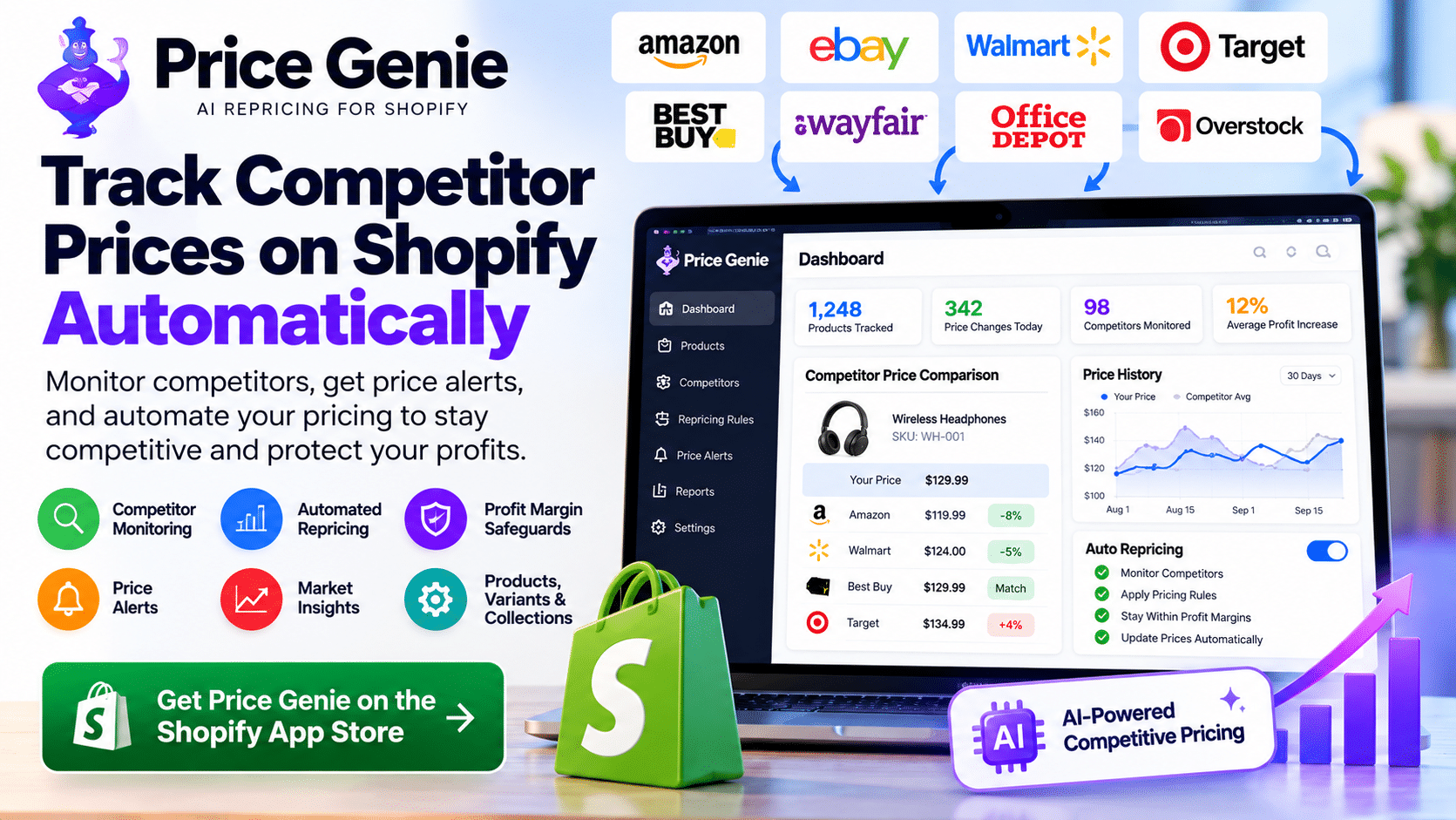
Price Genie is built specifically for Shopify merchants who want to monitor competitive prices and automate parts of their pricing strategy.
Instead of manually checking competing websites and repeatedly changing Shopify prices, merchants can use Price Genie to combine competitor monitoring with pricing rules and automation.
Price Genie provides tools for:
- Competitor price tracking
- Dynamic pricing automation
- Automated repricing rules
- Minimum and maximum pricing safeguards
- Competitor pricing alerts and insights
- Shopify-focused pricing management
Most importantly, the merchant defines the pricing strategy. Price Genie provides the tools needed to automate that strategy while maintaining greater control over how prices respond.
Explore the Price Genie Shopify pricing features to learn more about competitor monitoring, automated repricing, dynamic pricing, alerts, and pricing safeguards.
Dynamic Pricing and Shopify Pricing Strategy
Dynamic pricing should be part of a broader pricing strategy rather than treated as an isolated tool.
For example, merchants should consider:
- Product costs
- Desired profit margins
- Competitor prices
- Brand positioning
- Customer expectations
- Inventory considerations
- Shipping and fulfillment
- Pricing safeguards
Shopify provides additional information about evaluating product prices in its product pricing guidance.
Additionally, Shopify discusses the broader concept and different approaches in its guide to dynamic pricing.
Ultimately, combining competitive data with a clearly defined business strategy can help merchants make more informed pricing decisions.
Frequently Asked Questions About Shopify Dynamic Pricing
What is Shopify dynamic pricing?
Shopify dynamic pricing is a strategy that allows product prices to change according to predefined rules, competitor pricing, market information, or other selected conditions. Instead of manually deciding every price change, merchants can establish rules that guide how prices should respond.
Can Shopify automatically change product prices?
Yes. Third-party Shopify applications can provide pricing automation. Depending on the application, merchants can create rules and safeguards that determine when and how prices should change.
What is dynamic pricing software for Shopify?
Dynamic pricing software for Shopify helps merchants automate product pricing according to predefined rules and relevant pricing information. It can reduce repetitive manual pricing work while giving merchants greater control over how their stores respond to changing conditions.
Does dynamic pricing mean lowering prices?
No. Dynamic pricing does not automatically mean discounting products. Depending on the pricing strategy, a product price could decrease, increase, or remain unchanged.
What is the difference between dynamic pricing and repricing?
Dynamic pricing is the broader strategy of allowing prices to respond to changing information or conditions. Automated repricing is one method that can be used to implement that strategy by automatically changing prices according to predefined rules.
Can competitor prices be used for Shopify dynamic pricing?
Yes. Competitor pricing can be used as one of the signals within a dynamic pricing strategy. However, merchants should also consider costs, margins, pricing safeguards, and broader business objectives.
Can dynamic pricing software protect profit margins?
Pricing safeguards such as minimum-price thresholds can help prevent automated pricing rules from moving prices beyond predetermined limits. However, merchants should calculate appropriate thresholds based on their own costs and business requirements.
Does Price Genie offer dynamic pricing for Shopify?
Yes. Price Genie is designed specifically for Shopify merchants and combines competitor price monitoring, dynamic pricing tools, automated repricing rules, alerts, and pricing safeguards.
Start Building a Smarter Shopify Dynamic Pricing Strategy
Manually managing product prices becomes increasingly difficult as a Shopify catalog grows. At the same time, competitors and market conditions can change faster than merchants can reasonably monitor them by hand.
Fortunately, Shopify dynamic pricing can provide a more responsive and scalable approach. By combining competitive pricing information with merchant-defined rules and safeguards, Shopify stores can automate repetitive pricing decisions while maintaining greater control.
Furthermore, dynamic pricing software for Shopify can help merchants move beyond simply reacting to competitors. Instead, they can establish a structured pricing strategy designed around their own goals, margins, and competitive position.
Price Genie brings competitor monitoring, dynamic pricing, and automated repricing together for Shopify merchants. Explore Price Genie pricing plans and discover a smarter way to manage your Shopify pricing strategy.

0 Comments