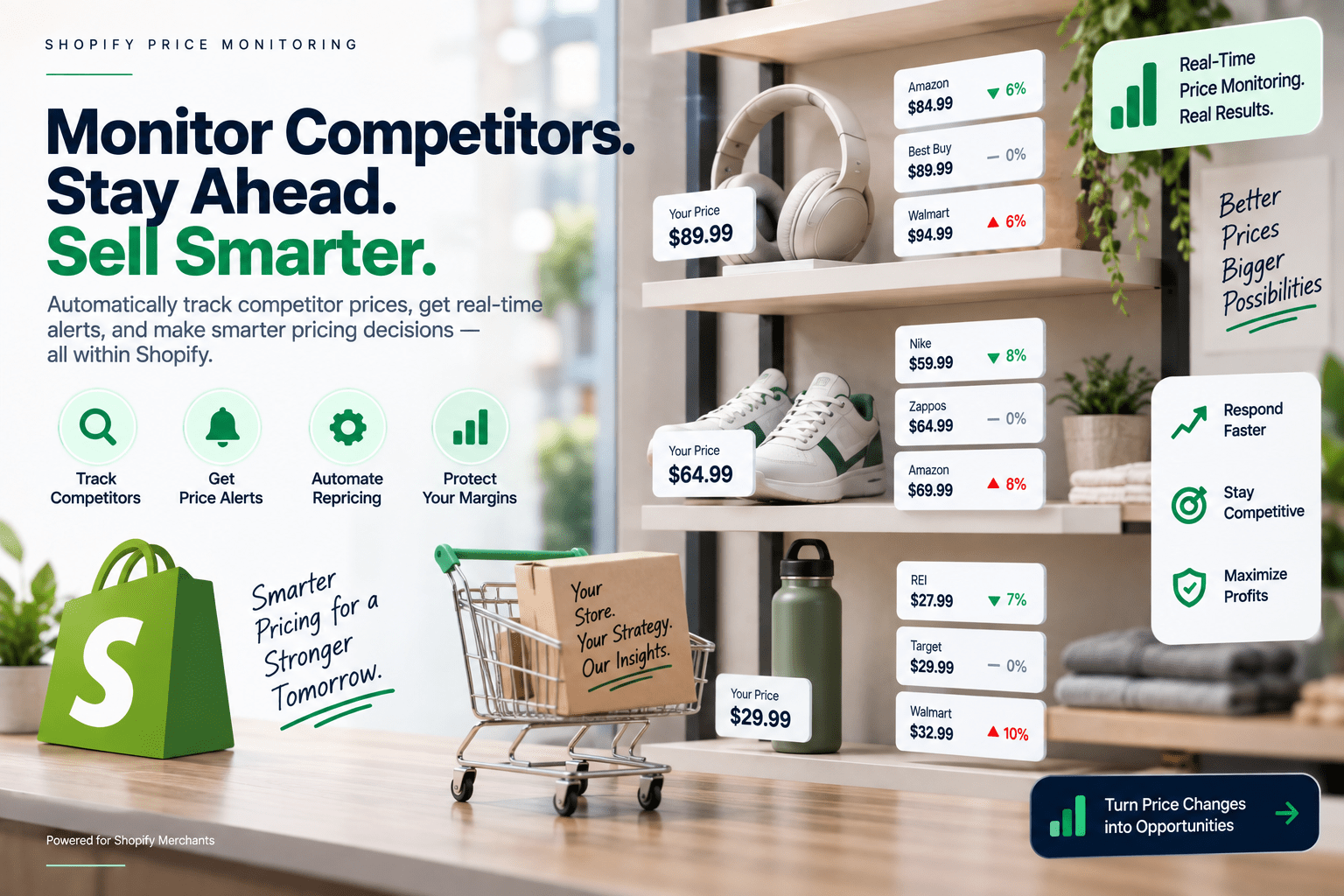
Shopify Price Monitoring: How to Monitor Competitor Prices Automatically
Keeping up with changing product prices can become a major challenge for Shopify merchants. Competitors may lower prices, increase prices, launch promotions, or make adjustments before you have time to notice. Fortunately, Shopify price monitoring can help merchants track these changes automatically instead of relying entirely on manual research.
For stores selling products that customers can easily compare across multiple retailers, pricing visibility can be especially valuable. In addition, using competitor price monitoring Shopify tools allows merchants to watch relevant competitors, identify price changes, and use that information to make more informed pricing decisions.
However, effective price monitoring is not simply about discovering who has the lowest price. Instead, the goal is to understand the competitive market and decide how your Shopify store should respond while considering margins, costs, brand positioning, and overall business objectives.
What Is Shopify Price Monitoring?
Shopify price monitoring is the process of tracking product prices across relevant competing retailers and comparing those prices with products in your Shopify store.
Rather than repeatedly visiting competitor websites, merchants can use automated tools to monitor selected products. When a competitor's price changes, the new information can then be used to evaluate your own pricing strategy.
As a result, price monitoring gives Shopify merchants greater visibility into what is happening across their competitive market. Moreover, this visibility can help reduce guesswork when deciding whether prices should remain the same, increase, or decrease.
How Does Competitor Price Monitoring for Shopify Work?
Competitor price monitoring Shopify software tracks selected competing products and identifies changes in their prices over time.
Although individual applications may work differently, the basic process generally includes:
- Selecting Shopify products to monitor
- Identifying relevant competitors
- Connecting competing product pages
- Monitoring competitor prices
- Detecting pricing changes
- Providing pricing alerts or insights
- Using the information to guide pricing decisions
Depending on the software, competitor information may also be combined with automated repricing rules. Consequently, merchants can move beyond simply monitoring the market and begin automating parts of their pricing strategy.
Furthermore, this type of automation can become increasingly valuable as a Shopify catalog grows and the number of competing products increases.
Why Shopify Price Monitoring Matters
Ecommerce prices do not necessarily remain the same for long periods. For example, competitors can adjust prices because of promotions, inventory levels, supplier costs, or broader pricing strategies.
Without regular monitoring, your Shopify store may continue using an outdated price while the competitive market changes around it. As a result, you could remain priced too high or, in some cases, unnecessarily low.
For example, price monitoring might reveal that:
- A major competitor lowered a product price
- Several competitors increased their prices
- Your product is significantly above the market
- Your product may be priced unnecessarily low
- A competitor launched a temporary promotion
- Pricing within a product category is changing frequently
Therefore, Shopify price monitoring can provide useful information for both defensive and opportunistic pricing decisions. In other words, monitoring is valuable not only when competitors cut prices but also when the market moves upward.
Manual vs. Automated Shopify Price Monitoring
Merchants can monitor competitor prices manually or use software to automate much of the process. However, the difference becomes increasingly important as a Shopify catalog grows.
Manual Shopify Price Monitoring
Manual monitoring typically requires merchants to visit competing product pages and record prices themselves.
For instance, the process might involve:
- Searching for competing products
- Opening multiple retailer websites
- Recording prices in spreadsheets
- Saving competitor product URLs
- Checking the same pages regularly
- Comparing new prices with previous prices
For a handful of products, this approach may be manageable. Once hundreds of products and multiple competitors are involved, though, the workload can increase dramatically.
Automated Competitor Price Monitoring for Shopify
Automated monitoring reduces the need to repeatedly perform the same research.
Instead, software can monitor selected competitor products and provide updated pricing information. Therefore, merchants can focus more attention on interpreting the data and deciding whether action is necessary.
Consequently, automation can make competitor price monitoring Shopify strategies more scalable. In addition, it can help merchants stay more consistent with their monitoring process.
How to Monitor Competitor Prices on Shopify
A successful monitoring strategy starts with selecting the right products and competitors. Simply tracking as many prices as possible does not necessarily provide better information.
1. Select Products for Shopify Price Monitoring
First, identify products where competitive pricing matters most.
Strong candidates may include:
- Best-selling products
- High-revenue products
- Products sold by multiple retailers
- Frequently discounted products
- Products with strong pricing competition
- Items where shoppers commonly compare prices
Starting with strategically important products can make monitoring easier to manage. Later, additional products can be added as the strategy expands.
Moreover, this approach allows merchants to learn which products benefit most from ongoing price monitoring before expanding to the entire catalog.
2. Identify Your Most Relevant Competitors
Next, determine which retailers genuinely compete for the same customers.
A relevant competitor might be:
- Another Shopify store
- A major online retailer
- An independent ecommerce website
- An online marketplace
- A specialty retailer in your industry
However, tracking every retailer selling a remotely similar product may create unnecessary noise. Instead, prioritize competitors your customers are realistically likely to consider.
As a result, the information you collect is more likely to support useful pricing decisions.
3. Connect Competing Products
Once competitors are identified, match their product pages with the corresponding products in your Shopify store.
This creates a direct comparison between your price and the competing offer. Additionally, it gives the monitoring system a specific product page to watch for pricing changes.
Therefore, careful product matching is important because poor matches can lead to misleading competitive comparisons.
4. Monitor Competitor Price Changes
After monitoring begins, watch for meaningful changes rather than focusing only on a single snapshot of the market.
For example, a competitor price moving from $89.99 to $84.99 provides useful information. Yet the history of that price can provide additional context.
Was $84.99 a normal price? Is it a temporary discount? Has the competitor repeatedly changed its price?
By looking at these patterns, merchants can make more deliberate pricing decisions. Furthermore, historical changes may help distinguish a temporary promotion from a longer-term shift in market pricing.
5. Decide Whether Your Shopify Price Should Change
Finding a competitor price change does not automatically mean your own price should change.
Instead, consider:
- Your product cost
- Your desired profit margin
- Your current price
- The competitor's price
- Brand positioning
- Shipping costs
- Customer service
- Inventory levels
- The importance of the competitor
By considering these factors together, merchants can avoid making pricing decisions based solely on the cheapest competitor. Therefore, competitor information becomes one part of the decision rather than the entire strategy.
Shopify Price Monitoring Can Identify Opportunities to Raise Prices
Competitor monitoring is often associated with lowering prices. However, the information can also reveal opportunities to evaluate price increases.
Imagine your Shopify store sells a product for $69.99. Meanwhile, three major competitors are selling the same product for $79.99, $81.99, and $84.99.
In that situation, your store may be significantly below the competitive market.
Depending on your broader pricing strategy, that information could provide a reason to evaluate whether a higher price would still remain competitive.
Therefore, Shopify price monitoring is not only about finding opportunities to reduce prices. It can also help identify situations where products may be priced lower than necessary.
Use Competitor Price Monitoring Shopify Data for Automated Repricing
Price monitoring tells merchants what is happening in the competitive market. Automated repricing can then determine how a Shopify product should respond according to predefined rules.
For example, consider this workflow:
- Your product sells for $99.99
- A selected competitor sells it for $94.99
- The competitor lowers its price to $89.99
- Your monitoring software identifies the change
- Your pricing rule evaluates the new competitor price
- Your minimum-price safeguard is checked
- Your Shopify price responds according to your strategy
As a result, competitive monitoring and automated repricing can work together as part of a larger pricing workflow.
Furthermore, this combination can reduce the delay between discovering a price change and responding to it. Price Genie combines these capabilities specifically for Shopify merchants. Explore the Price Genie Shopify pricing features to learn more about competitor monitoring, automated repricing, pricing rules, alerts, and safeguards.
Protect Profit Margins While Monitoring Competitor Prices
Competitive information is valuable, but another retailer should not completely determine your pricing strategy.
Suppose your product sells for $59.99 and your predetermined minimum acceptable price is $52.00.
Then, a competitor suddenly reduces its price to $47.99.
Matching that price may place your product below your preferred threshold. Instead, your pricing strategy can recognize the competitor's change without automatically following it.
For this reason, minimum-price safeguards can become particularly important when monitoring data is connected to automated repricing.
Moreover, safeguards can help merchants remain competitive without allowing short-term competitor activity to undermine long-term profitability.
What Features Should Shopify Price Monitoring Software Include?
Not every monitoring tool offers the same capabilities. Therefore, merchants should evaluate software according to the pricing strategy they want to implement.
Competitor Price Tracking
At a minimum, software should provide an efficient way to monitor selected competing product prices. In addition, the information should be easy to review and compare.
Price Change Alerts
Alerts can help merchants identify important changes without manually reviewing every monitored product. As a result, merchants can focus attention on changes that may actually require action.
Automated Repricing
Merchants who want greater automation should consider whether competitor information can be used within predefined repricing rules. Therefore, pricing data can become actionable rather than simply informational.
Minimum and Maximum Pricing Safeguards
Pricing boundaries can help prevent automated rules from moving products outside predetermined limits. Consequently, merchants can maintain greater control over automated changes.
Competitor Insights
Clear pricing information can make it easier to understand how your products compare with relevant competitors. Moreover, useful insights can help merchants identify broader pricing patterns.
Shopify Integration
Finally, Shopify merchants should consider how naturally the monitoring software fits into their existing ecommerce workflow. A smoother integration can make the overall pricing process easier to manage.
How Often Should You Monitor Competitor Prices?
There is no single monitoring frequency that works for every Shopify store.
A highly competitive market may experience frequent price changes. In contrast, another product category may remain relatively stable for weeks.
Several factors can influence the appropriate monitoring frequency:
- How often competitors change prices
- How many competitors sell the same products
- How price-sensitive customers are
- How quickly products sell
- How frequently promotions occur
- How important pricing is within the category
Automated monitoring can make this process easier because merchants do not have to remember when every competitor product was last checked. Therefore, stores can maintain more consistent visibility without relying entirely on manual schedules.
Shopify Price Monitoring vs. Dynamic Pricing
Price monitoring and dynamic pricing are related, but they serve different purposes.
Shopify price monitoring gathers competitive pricing information.
Dynamic pricing, on the other hand, allows product prices to respond to predefined conditions or pricing signals.
For example, a competitor price change identified through monitoring could become one of the signals used within a dynamic pricing strategy.
Therefore, monitoring provides information, while dynamic pricing determines how that information may influence your own prices.
Shopify Price Monitoring vs. Competitor Price Tracking
The terms price monitoring and competitor price tracking are often used interchangeably. Both generally describe the process of watching competing product prices for changes.
However, a broader price monitoring strategy can also involve analyzing pricing patterns, comparing multiple retailers, receiving alerts, and using the information within automated pricing rules.
Ultimately, both approaches share the same basic objective: providing merchants with better visibility into the competitive pricing environment.
Common Competitor Price Monitoring Mistakes
Monitoring more data does not automatically produce better pricing decisions. Therefore, merchants should avoid several common mistakes.
Tracking Too Many Irrelevant Competitors
Not every online retailer deserves equal attention. Instead, focus on competitors that realistically influence your customers.
Automatically Matching Every Price Drop
A competitor may temporarily discount a product for reasons that do not apply to your business. Consequently, automatically matching every reduction can create unnecessary margin pressure.
Ignoring Competitor Price Increases
Price monitoring should work in both directions. When competitors raise prices, your store may discover opportunities to reevaluate products that are priced significantly below the market.
Ignoring Your Own Product Costs
Competitive prices are only one part of a pricing decision. Therefore, your costs and desired margins should remain important factors.
Never Reviewing Your Monitoring Strategy
Competitors and markets change. Accordingly, merchants should periodically review which products and retailers they are monitoring.
Who Benefits Most From Shopify Price Monitoring?
Shopify price monitoring can be especially useful for merchants selling products that customers can easily compare across several retailers.
For example, stores selling the following products may benefit:
- Consumer electronics
- Beauty products
- Home and garden products
- Automotive accessories
- Pet supplies
- Sporting goods
- Tools and equipment
- Appliances
- Branded merchandise
- Other widely available retail products
On the other hand, competitor monitoring may play a smaller role for stores selling one-of-a-kind, handmade, highly customized, or proprietary products.
How Price Genie Simplifies Shopify Price Monitoring
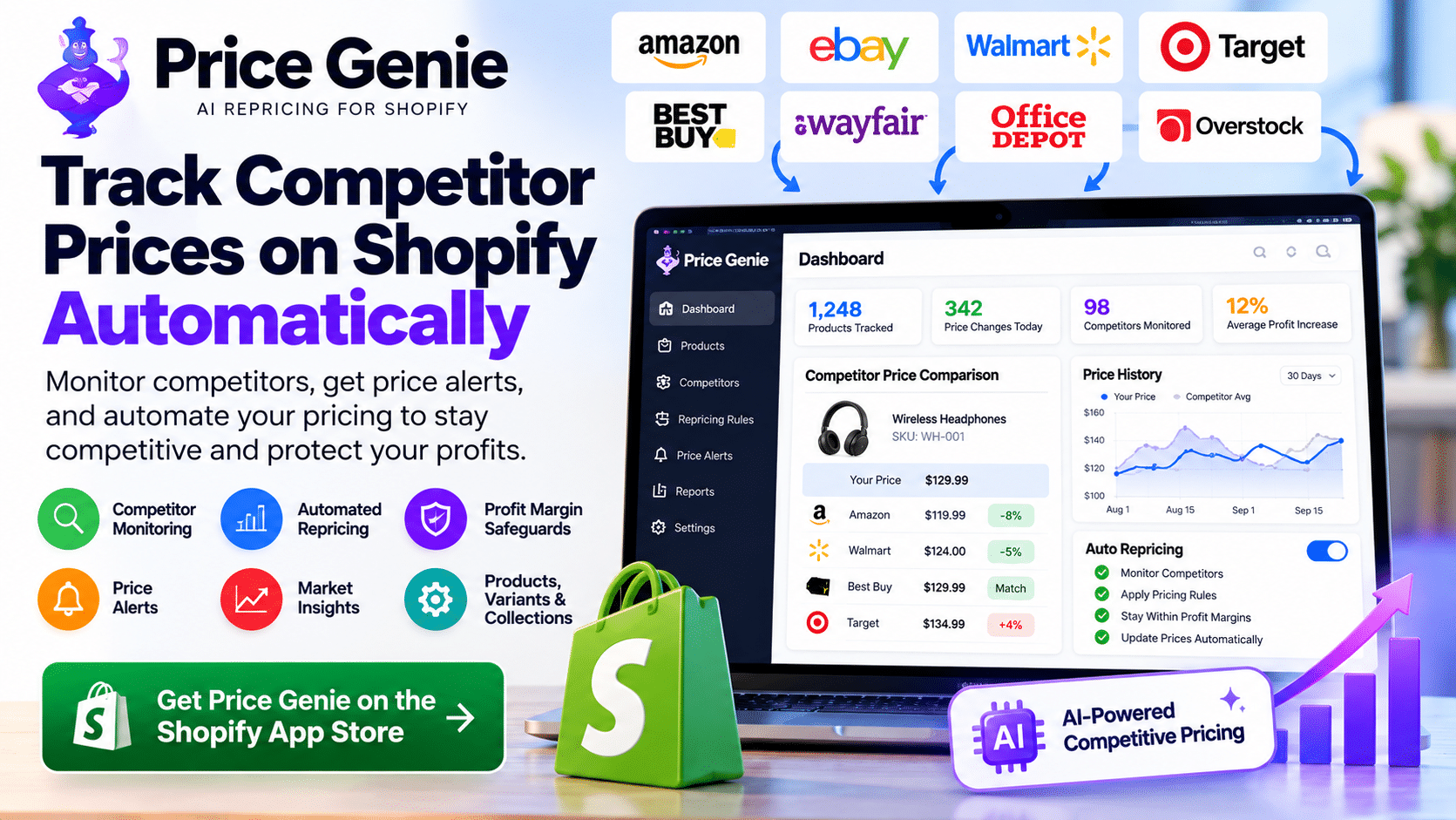
Price Genie is built specifically for Shopify merchants who want better visibility into competitor pricing and greater control over how their stores respond.
Rather than manually checking competing websites, merchants can use Price Genie to combine competitor monitoring with pricing automation.
Price Genie provides tools for:
- Competitor price monitoring
- Price change tracking
- Competitor alerts and insights
- Automated Shopify repricing
- Dynamic pricing automation
- Pricing rules
- Minimum and maximum pricing safeguards
Consequently, merchants can move beyond simply collecting competitor prices and begin using that information as part of a more structured Shopify pricing strategy.
In addition, bringing monitoring and automation together can make pricing workflows easier to manage as the business grows.
Build a Better Competitor Price Monitoring Shopify Strategy
A strong monitoring strategy should combine competitive information with the realities of your own business.
Important considerations include:
- Product costs
- Profit margins
- Relevant competitors
- Brand positioning
- Customer expectations
- Shipping costs
- Inventory
- Pricing safeguards
Shopify provides additional guidance for merchants evaluating product prices in its product pricing guide.
Additionally, Shopify discusses broader competitive pricing approaches in its competitive pricing guide.
By combining market information with your own costs and objectives, pricing decisions can become more deliberate and strategic. Furthermore, this approach reduces the risk of allowing competitor behavior alone to control your pricing.
Frequently Asked Questions About Shopify Price Monitoring
What is Shopify price monitoring?
Shopify price monitoring is the process of tracking relevant product prices across competing retailers and comparing those prices with products in your Shopify store. Automated tools can reduce the need to repeatedly check competitor websites manually.
Can Shopify automatically monitor competitor prices?
Yes. Shopify merchants can use third-party price monitoring software to track selected competitor products automatically. As a result, merchants can reduce repetitive manual checking.
What is competitor price monitoring for Shopify?
Competitor price monitoring Shopify tools help merchants track competing product prices, identify price changes, and use that information when making pricing decisions. In addition, some platforms can connect that information with pricing automation.
Can price monitoring automatically change Shopify prices?
Price monitoring itself gathers information. However, when monitoring software also includes automated repricing, competitor pricing information can be used within merchant-defined rules that determine whether a Shopify product price should change.
Should I always match a competitor's lower price?
No. Instead, another retailer's price should be considered alongside your costs, margins, brand positioning, shipping, customer service, and broader pricing strategy.
Can competitor monitoring tell me when to raise prices?
Yes. Competitor monitoring can reveal when competing retailers increase their prices or when your store is priced significantly below the market. Therefore, that information can help merchants evaluate whether their current price remains appropriate.
How many competitors should a Shopify store monitor?
There is no ideal number for every business. Instead, merchants should prioritize competitors that are most relevant to their products and customers.
Does Price Genie provide Shopify price monitoring?
Yes. Price Genie is designed for Shopify merchants and combines competitor price monitoring with pricing alerts, automated repricing, dynamic pricing tools, and pricing safeguards.
Start Monitoring Shopify Competitor Prices More Efficiently
Manually monitoring competitor prices can become increasingly difficult as a Shopify store grows. Meanwhile, competitors may continue adjusting prices between your manual checks.
Fortunately, automated Shopify price monitoring can reduce that repetitive workload while giving merchants greater visibility into changing market conditions.
More importantly, competitor price monitoring Shopify tools can provide information that supports better pricing decisions. When monitoring is combined with automated repricing, pricing rules, and safeguards, merchants can build a more complete pricing strategy.
Ultimately, the goal is not simply to watch competitors. Instead, the goal is to use competitive information to make smarter pricing decisions while maintaining control over margins and strategy.
Price Genie brings these capabilities together specifically for Shopify merchants. Explore Price Genie pricing plans and discover a more efficient way to monitor competitors and manage your Shopify pricing strategy.

0 Comments